


Are any of you on Facebook? I know, I know…it's not so cool anymore with the younger generation. I, however, am on Facebook and there's been a post going around asking people who are tagged to make a post of the ten books that have changed their life. Mrs. Kinross, MHS 10th grade teacher, tagged me in this post. And to be honest, I replied to her with some book suggestions but wasn't quite ready to make my list. I still am not sure I am ready. Only ten books? The pressure is too much.
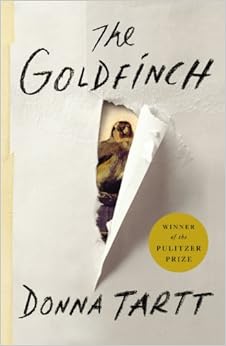
But I recently finished a novel that I feel confident I would place on that list of top ten. It is called The Goldfinch by Donna Tartt. The only reason I requested it from the library was because I had seen so many of my Goodreads friends suggesting it, as well as bestseller lists. I thought it was amazing. I will also tell you that it was LONG. 771 pages long.
Okay, so here's the abbreviated version of those 771 pages. It begins when Theo is a thirteen year old. He and his mom stop at a museum in New York City briefly to examine some paintings. While they are there, a bomb goes off (well, two actually) and his mother dies. Theo meets a man named Welty after the bombing but before he escapes. Welty gives him a ring and tells him to save this famous painting of a goldfinch. Theo obliges and runs home with the painting and ring, never telling authorities about it. The painting follows him from place to place….to Vegas to live with his father and his girlfriend, back to New York City to live with a friend and confidante, Hobie, who later becomes his business partner.
There are so many things I loved about this book. It is hard to keep my attention for 771 pages, but Donna Tartt was able to do just that. Her characterization was well developed, and not just for the main character, Theo. I felt like his good friend Boris could just walk off the page and introduce himself to me. My heart tugged for Mrs. Barbour towards the end of the book when two people very close to her died. When you feel like you know a character, like you could meet them in real life, like you see a person on the street and think, "That's Boris!" then that is plain 'ol good writing.
I also loved the imagination the author must have to spin such a creative, imaginative plot. Every twist in Theo's life was unexpected to me and I loved that. I also appreciated that Theo's character was not perfect. Far from it actually. Theo did a lot of bad, bad things over the course of the book, but was still able to learn things from his experiences.
And since a post would not be complete without some quotes from the text, I'll leave you with a few of my favorites. "Isn't everything worthwhile a gamble? Can't good come around sometimes through some strange back doors?" (Tartt 758). This line addresses that earlier notion of Theo not always making the best choices or causing the best actions, but sometimes things still ended up okay. Sometimes even better than okay and he was able to grow from his experiences.
The other line that really spoke to me reads, "A great sorrow, and one that I am only beginning to understand: we don't get to choose our own hearts. We can't make ourselves want what's good for us or what's good for other people. We don't get to choose the people we are" (Tartt 761). This line comes near the end of the book when Theo is reflecting on his experiences through his journey. So universal and it spoke to me as both a parent and a teacher. My children are not exactly like me. Neither are my students. And that's okay. They are who they are. Something for me to embrace and appreciate.
Wednesday, September 24, 2014

Sunday, September 14, 2014
Golden Lines
You know those lines that you read that you feel like everyone should read? That almost feel like thematic statements themselves? That make you wish you had written them yourself? That's what todays' post is going to be about. I've actually read about five books since my last post, so these lines are going to be from a hodgepodge of different authors.
This first is from Left to Tell, which I blogged about last week. Here is the line: "Mr. Mehu introduced me to his secretary, Jeane, and she spent the day showing me how to use the computer and write memos, along with the ins and outs of their filing system. I memorized every function of every button on the computer, and then I drew an exact replica of the keyboard on a piece of cardboard. I spent three days working on the computer, and stayed up three entire nights practicing, typing on my own hand drawn keyboard" (Ilibagiza 189). I love what this says about hard work. Can't you just imagine the amazing thematic statement that could come from this: If one works hard, any goal can be achieved. I too often today people just expecting something, a new car, to be the best in a sport or subject, etc. without putting in any hard work. Unfortunately, I see this with my own children at times already. And the older two are only four and six! My four year old plays soccer. He never wants to practice with me at home, but then wonders why he hasn't scored a goal yet. He is not understanding (at least not yet) the importance of hard work. I see it with students at the end of a grading period (in former years of course) who will rush in the last week, requesting extra credit and all of a sudden wondering how they can bring their grade up from a D. Well, the answer my friends, is hard work and putting in the effort. Just like Immaculee did in Left to Tell.
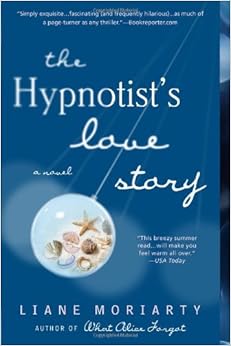
Another book I read at home was called The Hypnotist's Love Story by Liane Moriarty. Another book full of golden lines. So many, I had to pick two:
"This was the problem with being friends with someone who knew you when you were a teenager. They never quite take you seriously because they always see you as your stupid teenage self" (Moriarty 43).
"Over the last few months she'd learned that anything she thought she knew to be true could shift and change in an instant. Nothing was permanent: The Buddhists knew what they were talking about" (Moriarty 391).
I like both these lines. The first, just because the advice is simple, but I know the audience of this blog is teenagers, so I picked a line that could possibly speak to you. That being said, some of my best friends in this world are from high school. We still meet for monthly dinners, birthday parties, and our soirees have grown to include our husbands and children. So even though I love the line, I don't think it applies to me all that much. I could definitely see how it could though…
The second line appeals to those moments that are life-changing. You can think everything is going hunky-dory perfect in your life. Until there is a life-changing medical diagnosis. Or a death of a loved one. Or a move. Or the loss of a pet. These moments that you remember forever. And that seem to change everything that instant.
I have more lines ready, but unfortunately it is 6:15 on a Sunday morning and my children are starting to wake up, which means it is time for me to make pancakes. Yum!
I will leave you with the next quote I was going to talk about instead. This comes from The Goldfinch, a novel I started last week but has quickly consumed me. It is FANTASTIC!
"Every new event--everything I did for the rest of my life--would only separate us more and more: days she was no longer a part of, an ever-growing distance between us. Every single day for the rest of my life, she would only be further away" (Tartt 89).
Please respond in the comments: What does this line mean to you? What do you think is happening to these characters? Can you make any predictions just from this one line?
Thursday, August 28, 2014
Left to Tell: Discovering God Amidst the Rwandan Holocaust
Left to Tell is join going to be an upcoming literature circle novel for our CP students. The unit will focus on multicultural memoirs. Multicultural meaning it's written about an experience outside the United States and memoir meaning it is told by the person who went through the experience. I have to say that this book was the one I knew the least about when we started planning the unit. I was 13 years old when the Rwandan Holocaust occurred and it was not something I knew much about. Okay, anything. At least at the time.
But I did know about Hotel Rwanda, a Hollywood film created in 2004 that depicts the Holocaust from the eyes of Paul Rusebagina, who attempts to shelter his own family and over a thousand other refugees at the hotel he managed. Though the movie was not real, the story of Paul was real. And the event was real. It's hard to believe that something so much like the Holocaust during WW2 could happen again. More than 50 years later. It's like the Rwandans didn't learn anything from that experience, nor the rest of the world, who failed to come to the aid of the Tutsi's being persecuted. Here is a short clip from the film, showing the chaos in the streets, the fear of the citizens, and the brutality of the Holocaust. (Don't worry…nothing too violent).
The whole purpose of talking about this film is that I had some background knowledge before I actually picked up the book and started reading. And I'm glad. Questions I had in the movie were easily explained by Immaculee in her memoir. If you click on the hyperlink in the first paragraph, you can read a short summary of Immaculee's story. Immaculee was a successful, smart young woman who had her entire life on the horizon. She did well in school, earning a scholarship to University. She had friends and aspirations, a loving family. When the genocide began, her father begged her to come back from University for the Easter break. Immaculee was so glad she did. She was able to see her family one last time. When the rebels started the attacks and began looking for her family, she escaped to a local pastor's house and was hidden with six other women in a bathroom for the three month duration. Currently, I am at the part where she is hiding in the bathroom. She must remain absolutely silent while hiding.
I love her word choice here, where she is describing what it was like when the rebels were actually at the pastor's house to start searching for her: "Hundreds of people surrounded the house, many of whom were dressed like devils, wearing skirts of tee bark and shirts of dried banana leaves, and some even had goat horns strapped onto their heads. Despite their demonic costumes, their faces were easily recognizable, and there was murder in their eyes" (Ilibagiza 77). You can only imagine the terror she felt at that moment. During another attempt and finding the women at the pastor's house, Immaculee reflects, "Prayer became my armor, and I wrapped it tightly around my heart" (Ilibagiza 85). I loved the personification used here. Immaculee is a strong writer. Combine that with a gripping story and you have a recipe for a you-can't-put-it-down book. I hope some of you choose to read this during our multicultural memoir unit!

But I did know about Hotel Rwanda, a Hollywood film created in 2004 that depicts the Holocaust from the eyes of Paul Rusebagina, who attempts to shelter his own family and over a thousand other refugees at the hotel he managed. Though the movie was not real, the story of Paul was real. And the event was real. It's hard to believe that something so much like the Holocaust during WW2 could happen again. More than 50 years later. It's like the Rwandans didn't learn anything from that experience, nor the rest of the world, who failed to come to the aid of the Tutsi's being persecuted. Here is a short clip from the film, showing the chaos in the streets, the fear of the citizens, and the brutality of the Holocaust. (Don't worry…nothing too violent).
I love her word choice here, where she is describing what it was like when the rebels were actually at the pastor's house to start searching for her: "Hundreds of people surrounded the house, many of whom were dressed like devils, wearing skirts of tee bark and shirts of dried banana leaves, and some even had goat horns strapped onto their heads. Despite their demonic costumes, their faces were easily recognizable, and there was murder in their eyes" (Ilibagiza 77). You can only imagine the terror she felt at that moment. During another attempt and finding the women at the pastor's house, Immaculee reflects, "Prayer became my armor, and I wrapped it tightly around my heart" (Ilibagiza 85). I loved the personification used here. Immaculee is a strong writer. Combine that with a gripping story and you have a recipe for a you-can't-put-it-down book. I hope some of you choose to read this during our multicultural memoir unit!
Wednesday, August 13, 2014
Mrs. Palmer's Summer Reading
This post will be a bit atypical from my normal posts. I typically focus on one text and go into detail about some of it's features. Today, I plan to highlight several books I've read over the summer since I took a blogging hiatus.
Maus
This book is a graphic novel…to be honest, it's the first graphic novel I've actually read in its entirety. I guess I always had a preconceived notion that graphic novels were too simplistic and didn't carry much of a story line. I stand corrected. Maus was interesting, forced me to use both pictures and words to tell a complete story (something I only do when reading picture books with my children), and actually quite serious in plot. It is a story about the Holocaust, told from the perspective of a young Jewish boy interviewing his father, a man who survived the Holocaust. What I was expecting to be an unrealistic cartoon surprised me; it was powerful. Some of you will have the opportunity to read this later during our multicultural memoir unit this Fall. If you want to know more, click here.
 The Death of Bees
This was the first book I read this summer. I selected it because it was one of the Alex Award winners, so I knew some students may come in this school year and chose this for summer reading. The premise of this book was actually quite crazy, and I'm being somewhat vague to avoid spoilers, but here it is: Two girls find their father and mother both dead in their rundown house. Their parents were horrible to them, so instead of calling the authorities, they decide to bury them in their backyard and just live by themselves, pretending the parents ran off on an adventure when anyone close to them asked. The girls end up becoming friends with a neighbor…and I have to stop here or I'll spoil something. I LOVED this book! Read more here.
The Universe Versus Alex Woods
This was another book title that appeared on the Alex Award list. This one took me a bit longer to get through than The Death of Bees, though I still did enjoy it. This title was about a boy named Alex Woods who was struck by a meteor at the age of ten and suffered some health consequences as a result, such as seizures. The novel starts right in the action of Alex trying to cross a European border with a dead man's ashes in the car. Then the whole book flashes back to the events leading up to this pseudo-arrest. There are definitely moments where this one seemed farfetched, but I didn't really mind. The author kept you interested and the characterization was impeccable. Another YA book with my stamp of approval!
These were the only three YA books I read this summer. I can't wait to hear about your summer reading!
Maus
This book is a graphic novel…to be honest, it's the first graphic novel I've actually read in its entirety. I guess I always had a preconceived notion that graphic novels were too simplistic and didn't carry much of a story line. I stand corrected. Maus was interesting, forced me to use both pictures and words to tell a complete story (something I only do when reading picture books with my children), and actually quite serious in plot. It is a story about the Holocaust, told from the perspective of a young Jewish boy interviewing his father, a man who survived the Holocaust. What I was expecting to be an unrealistic cartoon surprised me; it was powerful. Some of you will have the opportunity to read this later during our multicultural memoir unit this Fall. If you want to know more, click here.
This was the first book I read this summer. I selected it because it was one of the Alex Award winners, so I knew some students may come in this school year and chose this for summer reading. The premise of this book was actually quite crazy, and I'm being somewhat vague to avoid spoilers, but here it is: Two girls find their father and mother both dead in their rundown house. Their parents were horrible to them, so instead of calling the authorities, they decide to bury them in their backyard and just live by themselves, pretending the parents ran off on an adventure when anyone close to them asked. The girls end up becoming friends with a neighbor…and I have to stop here or I'll spoil something. I LOVED this book! Read more here.
The Universe Versus Alex Woods
This was another book title that appeared on the Alex Award list. This one took me a bit longer to get through than The Death of Bees, though I still did enjoy it. This title was about a boy named Alex Woods who was struck by a meteor at the age of ten and suffered some health consequences as a result, such as seizures. The novel starts right in the action of Alex trying to cross a European border with a dead man's ashes in the car. Then the whole book flashes back to the events leading up to this pseudo-arrest. There are definitely moments where this one seemed farfetched, but I didn't really mind. The author kept you interested and the characterization was impeccable. Another YA book with my stamp of approval!
These were the only three YA books I read this summer. I can't wait to hear about your summer reading!
Friday, June 6, 2014
Paper Towns
Don't get mad. I just did what I always tell you not to do. I used wikipedia. For the definition of paper towns, which is as follows, "Fictitious entries, also known as fake entries, Mountweazels, ghost words[1] and nihil articles, are deliberately incorrect entries or articles in reference works such as dictionaries, encyclopedias, maps, and directories. Entries in reference works normally originate from a reliable external source, but no such source exists for a fictitious entry.Copyright trap is a specific case where the motivation for the entry is to detect plagiarism or copyright infringement."

It is pretty important to know the meaning behind paper towns, since it is the title of John Green's book. I've had pretty hit or miss luck with John Green lately. I loved The Fault in our Stars can can't wait to see the movie. I thought Looking for Alaska and An Abundance of Katherines were okay. Way too many curse words in my opinion. But Paper Towns did not disappoint. I loved the character development of both Quentin "Q" and Margo Roth Spiegelman (You just have to use all three of her names when speaking about her).
John Green is excellent with his character development. Even though Margo Roth Spiegelman ran away early in the book, she was still well developed from the messages and clues she left behind for Q to find. She was the planner of events, the internalizer, the one who liked things done her way. One quote that resounded with me, not because it was particularly wise, but for the nice detail into her character was a line she spoke, "Yeah. I'm a big believer in random capitalization. The rules of capitalization are so unfair to words in the middle." This line comes into play when Q recognizes writing of hers on an online urban dictionary that demonstrates this unique pattern of capitalization.
I also like Green's writing style and description. He is able to make even the smallest, minute thing important and appear in the reader's mind because he slows down his description. Check out this description and see if you can guess what he is describing: "There is so much to recommend this house. It is carpeted throughout. It has central air-conditioning and heating. The whole place is wired for surround sound. Admittedly, it contains only fifty-five square feet of living space. But you can't beat the open floor plan." Take a guess in the comments and I'll let you know next post. (This will also be a true test if anyone is still reading my blog since it is now summer break…)
It is pretty important to know the meaning behind paper towns, since it is the title of John Green's book. I've had pretty hit or miss luck with John Green lately. I loved The Fault in our Stars can can't wait to see the movie. I thought Looking for Alaska and An Abundance of Katherines were okay. Way too many curse words in my opinion. But Paper Towns did not disappoint. I loved the character development of both Quentin "Q" and Margo Roth Spiegelman (You just have to use all three of her names when speaking about her).
John Green is excellent with his character development. Even though Margo Roth Spiegelman ran away early in the book, she was still well developed from the messages and clues she left behind for Q to find. She was the planner of events, the internalizer, the one who liked things done her way. One quote that resounded with me, not because it was particularly wise, but for the nice detail into her character was a line she spoke, "Yeah. I'm a big believer in random capitalization. The rules of capitalization are so unfair to words in the middle." This line comes into play when Q recognizes writing of hers on an online urban dictionary that demonstrates this unique pattern of capitalization.
I also like Green's writing style and description. He is able to make even the smallest, minute thing important and appear in the reader's mind because he slows down his description. Check out this description and see if you can guess what he is describing: "There is so much to recommend this house. It is carpeted throughout. It has central air-conditioning and heating. The whole place is wired for surround sound. Admittedly, it contains only fifty-five square feet of living space. But you can't beat the open floor plan." Take a guess in the comments and I'll let you know next post. (This will also be a true test if anyone is still reading my blog since it is now summer break…)
Monday, May 26, 2014
The Selection Series Ends :(
You might think from the sad face I didn't like the book. Not the case. I actually loved it. I am just sad it's over. Coming from me, this says a lot. Normally I completely dislike third books in trilogies. I wasn't crazy about Mockingjay. I didn't even like the second book in the Matched series.
This series though. I loved it. You can read my blog post about The Selection here. This gives a basic premise of the plot line. The second book, The Elite, narrows the playing field down even more, and by the time The One starts, only four girls remain: Elise, Kriss, Celeste, and America. Obviously, America is one of them. In the third installment, situations at the castle are getting tense as both the northern and southern rebels continue to attack the castle and the Elite. It is nice for America that one of the guards was also from her home district and he continues to protect her as much as he can. I know I am being vague, but this is my meager attempt and not spoiling anything. Was I successful?
The second book I am going to blog about today was called The Prince. This was a novella about the beginning of the whole selection process told from Prince Maxon's point of view. I think Kiera Cass did a great job of switching voices so that we weren't hearing America, but Maxon. The writing was different and I could hear a new voice, which I appreciate as an English teacher. We had heard the whole love story from the girl's perspective, and this particular line from the guy's perspective stood out: "I debated hopping into the hallway on the second floor so we could accidentally-on-purpose meet again." I loved the hyphenated modifier…and I loved that he knew right away that this girl was special.
In all, this series was a bit cheesy. In my initial post where I suggested, "It is kind of The Hunger Games meets The Bachelor," I was pretty accurate. If you are a young adult girl, I would highly recommend this series. It would make good summer reading material. And if you've already read (and loved) the series, I just discovered there is another novella called The Queen being released. Cass is satisfying her readers' hunger. And who knows? This just may be the next book turned Hollywood movie…
If you want to get a glimpse into what this book is like, check out the author reading the first chapter here:
This series though. I loved it. You can read my blog post about The Selection here. This gives a basic premise of the plot line. The second book, The Elite, narrows the playing field down even more, and by the time The One starts, only four girls remain: Elise, Kriss, Celeste, and America. Obviously, America is one of them. In the third installment, situations at the castle are getting tense as both the northern and southern rebels continue to attack the castle and the Elite. It is nice for America that one of the guards was also from her home district and he continues to protect her as much as he can. I know I am being vague, but this is my meager attempt and not spoiling anything. Was I successful?
The second book I am going to blog about today was called The Prince. This was a novella about the beginning of the whole selection process told from Prince Maxon's point of view. I think Kiera Cass did a great job of switching voices so that we weren't hearing America, but Maxon. The writing was different and I could hear a new voice, which I appreciate as an English teacher. We had heard the whole love story from the girl's perspective, and this particular line from the guy's perspective stood out: "I debated hopping into the hallway on the second floor so we could accidentally-on-purpose meet again." I loved the hyphenated modifier…and I loved that he knew right away that this girl was special.
In all, this series was a bit cheesy. In my initial post where I suggested, "It is kind of The Hunger Games meets The Bachelor," I was pretty accurate. If you are a young adult girl, I would highly recommend this series. It would make good summer reading material. And if you've already read (and loved) the series, I just discovered there is another novella called The Queen being released. Cass is satisfying her readers' hunger. And who knows? This just may be the next book turned Hollywood movie…
If you want to get a glimpse into what this book is like, check out the author reading the first chapter here:
Saturday, May 17, 2014
The World is Ending...
Or at least that is the premise of The Last Survivors Series written by Susan Beth Pfeffer. I had never read anything by this author before, but when I saw the title as both a Goodreads recommendation as well as on the list of top teen downloads from Overdrive at the Cincinnati Public Library, I figured I'd give it a whirl.
I DEVOURED this book in a matter of days. The storyline was so different from anything I'd ever read before. It's not exactly dystopian literature, but if you like that type of reading, you would also probably like Life As We Know It, the first book in the series. The story starts like any realistic fiction book, by introducing us to the main characters and the Pennsylvania town where they live, complete with the students abuzz about that night's homework assignment: to watch an asteroid hit the moon. Scientists have been buzzing about it for days; now, students finally get to witness the impact. But things don't go exactly as planned. The asteroid knocks the moon off it's orbit and it becomes too close to the Earth. And the effects are drastic. Tsunamis and earthquakes and angry tides. It seems Mother Nature is dumping everything on the world at once. Miranda's mother goes nuts and takes the kids out of school right away and heads straight to the grocery store where they load up on all sorts of nonperishable food and supplies to stock their home. Her brothers spend days chopping trees on their property and filling the house with firewood. Things go from bad to worse in a matter of about a month. Soon, there is no more sunshine and the sky is filled with gray dust. Then the climate has a major switch and it starts to freeze in August, shortly followed by full-blown winter with temps below zero. Many die. Many. But somehow, Miranda and her family all survive, living in the sunroom of their house, staying as warm as possible with the aid of their wood-burning stove. I don't want to spoil the end of the novel, but there is a sudden change with a chance for hope.
I was so eager to start the second novel, The Dead and the Gone, because I liked the first one so much. So I was a tad disappointed when I downloaded the book to my Kindle to discover that it wasn't continuing Miranda's story, but instead telling the story of another family that faces the same crisis, this time in New York City. The writing is still strong and I'm starting to connect to these characters. However, I do hope Pfeffer continues the story of Miranda and her family in the 3rd or 4th book in the series.
For now, it has made me wonder about the possibility of natural disaster and how my family would survive. We have zero food reserves. Zero. Does anyone stockpile food in the case of natural disaster? I had a student write his creative nonfiction piece about this topic earlier this trimester. Combined with this series, it really made me think about the idea. It couldn't hurt to have a few extra canned good lying around. Could it?
I DEVOURED this book in a matter of days. The storyline was so different from anything I'd ever read before. It's not exactly dystopian literature, but if you like that type of reading, you would also probably like Life As We Know It, the first book in the series. The story starts like any realistic fiction book, by introducing us to the main characters and the Pennsylvania town where they live, complete with the students abuzz about that night's homework assignment: to watch an asteroid hit the moon. Scientists have been buzzing about it for days; now, students finally get to witness the impact. But things don't go exactly as planned. The asteroid knocks the moon off it's orbit and it becomes too close to the Earth. And the effects are drastic. Tsunamis and earthquakes and angry tides. It seems Mother Nature is dumping everything on the world at once. Miranda's mother goes nuts and takes the kids out of school right away and heads straight to the grocery store where they load up on all sorts of nonperishable food and supplies to stock their home. Her brothers spend days chopping trees on their property and filling the house with firewood. Things go from bad to worse in a matter of about a month. Soon, there is no more sunshine and the sky is filled with gray dust. Then the climate has a major switch and it starts to freeze in August, shortly followed by full-blown winter with temps below zero. Many die. Many. But somehow, Miranda and her family all survive, living in the sunroom of their house, staying as warm as possible with the aid of their wood-burning stove. I don't want to spoil the end of the novel, but there is a sudden change with a chance for hope.
I was so eager to start the second novel, The Dead and the Gone, because I liked the first one so much. So I was a tad disappointed when I downloaded the book to my Kindle to discover that it wasn't continuing Miranda's story, but instead telling the story of another family that faces the same crisis, this time in New York City. The writing is still strong and I'm starting to connect to these characters. However, I do hope Pfeffer continues the story of Miranda and her family in the 3rd or 4th book in the series.
For now, it has made me wonder about the possibility of natural disaster and how my family would survive. We have zero food reserves. Zero. Does anyone stockpile food in the case of natural disaster? I had a student write his creative nonfiction piece about this topic earlier this trimester. Combined with this series, it really made me think about the idea. It couldn't hurt to have a few extra canned good lying around. Could it?
Subscribe to:
Posts (Atom)